Methodology
How we decide whether a site is down
Every status page combines up to three sources: problem reports from people using the service, our own automated checks for websites, and, where the service publishes one, its official status page. This page explains how each works and where their limits are.
Last updated
The three statuses
A status page always shows one of three labels, with the numbers behind it next to it:
- No problemsReports are within the usual range for this time of day, and our check of the website (if there is one) passes.
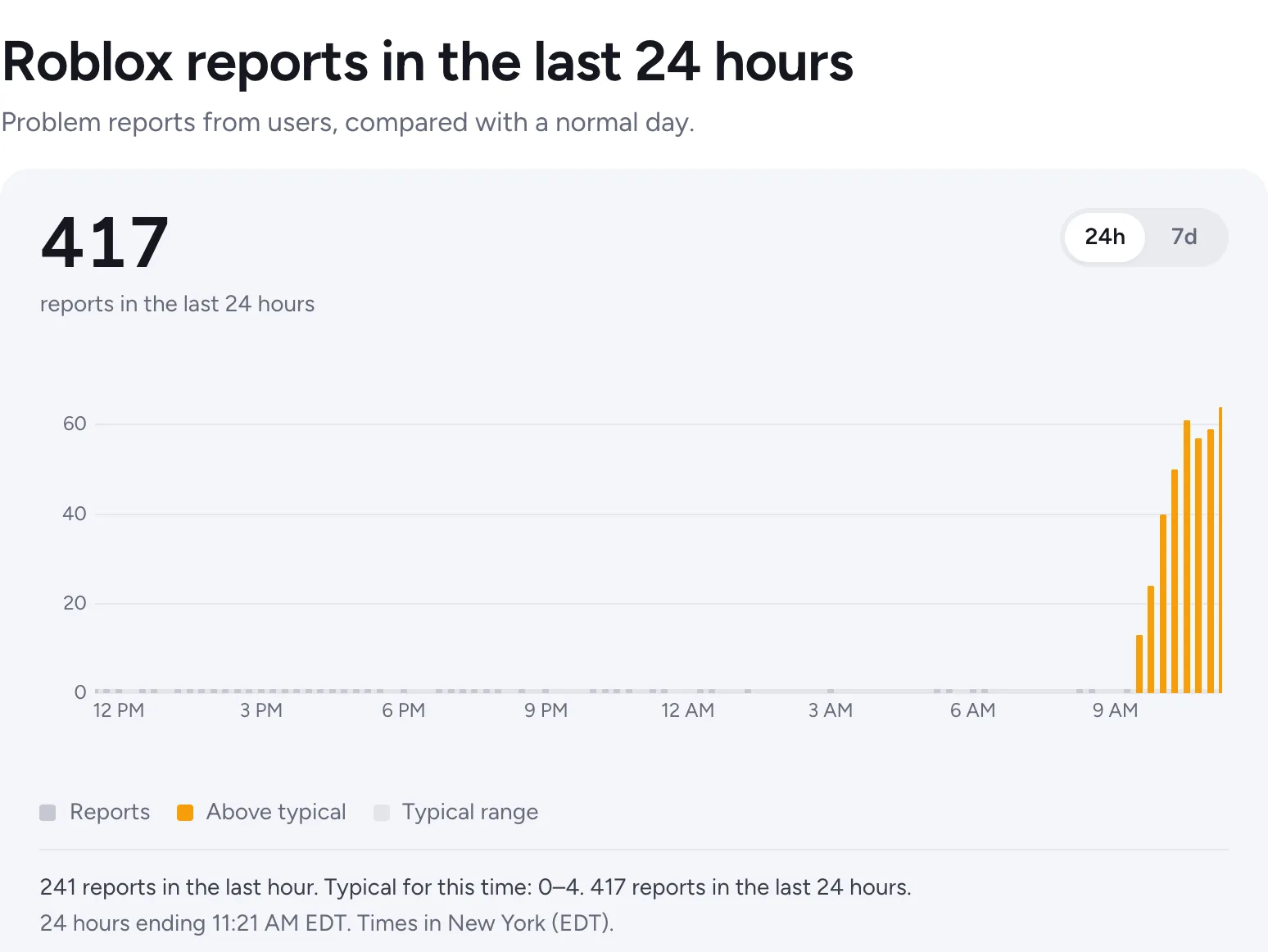
- Possible problemsAt least 4 reports in the last hour and more than the top of the usual range. Something may be wrong; we are watching.
- Problems detectedAt least 10 reports in the last hour and at least twice the top of the usual range, or our check of the website failed twice in a row.
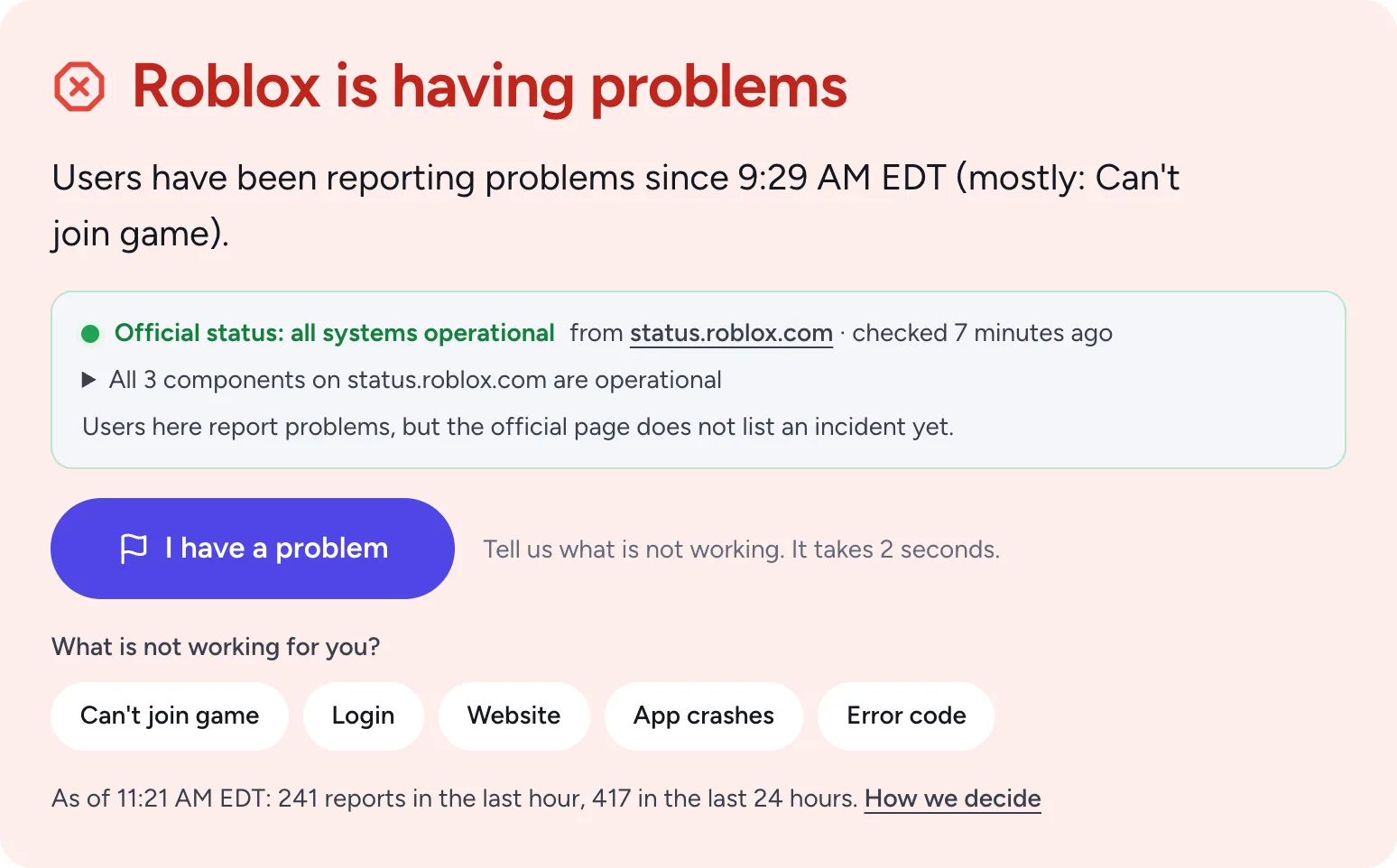
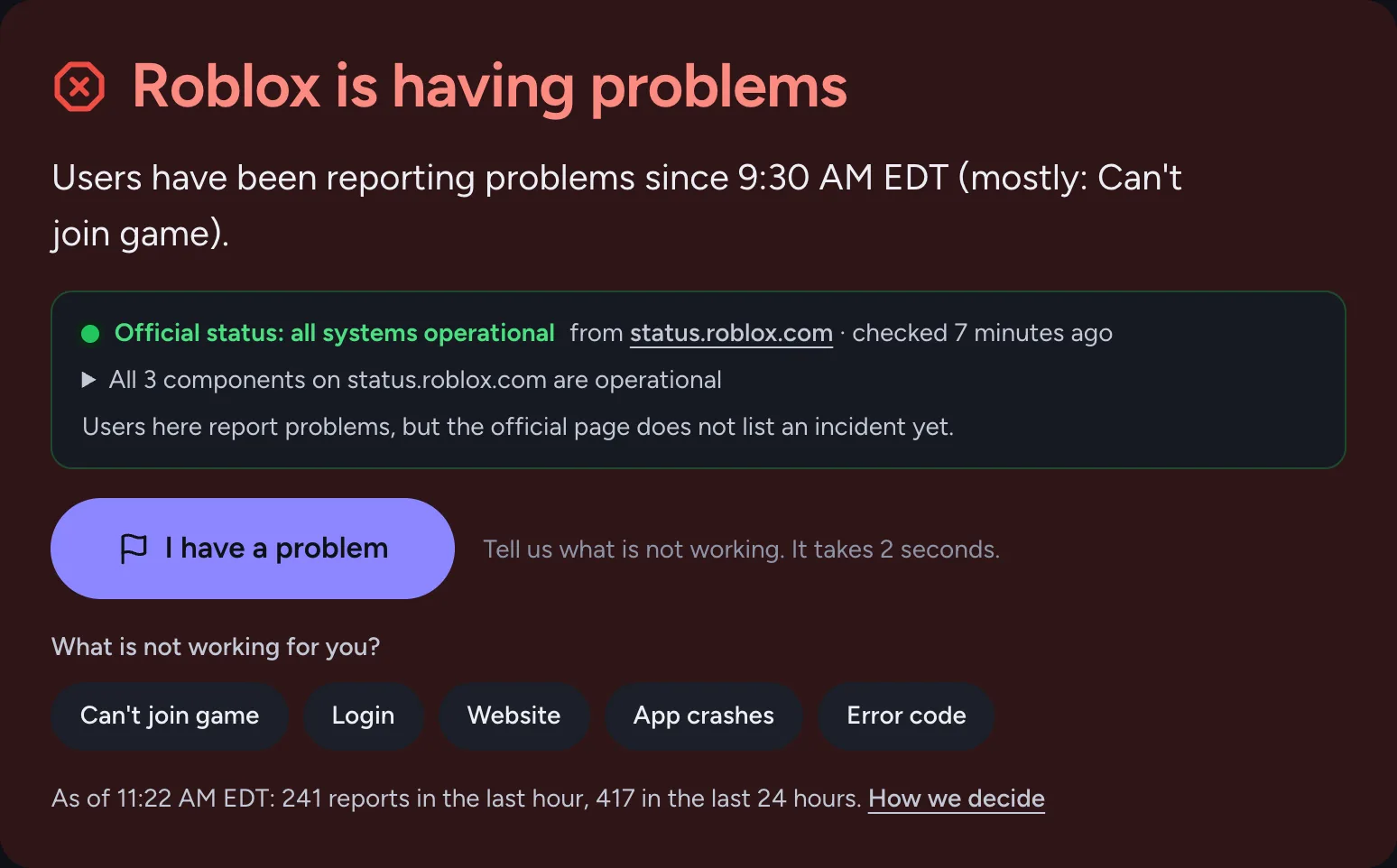
Lists of services (the home page, categories and search) use a quicker rule: at least 3 reports in the last hour shows "possible problems", at least 10 shows "problems", and so does a website our check has confirmed down.
User reports
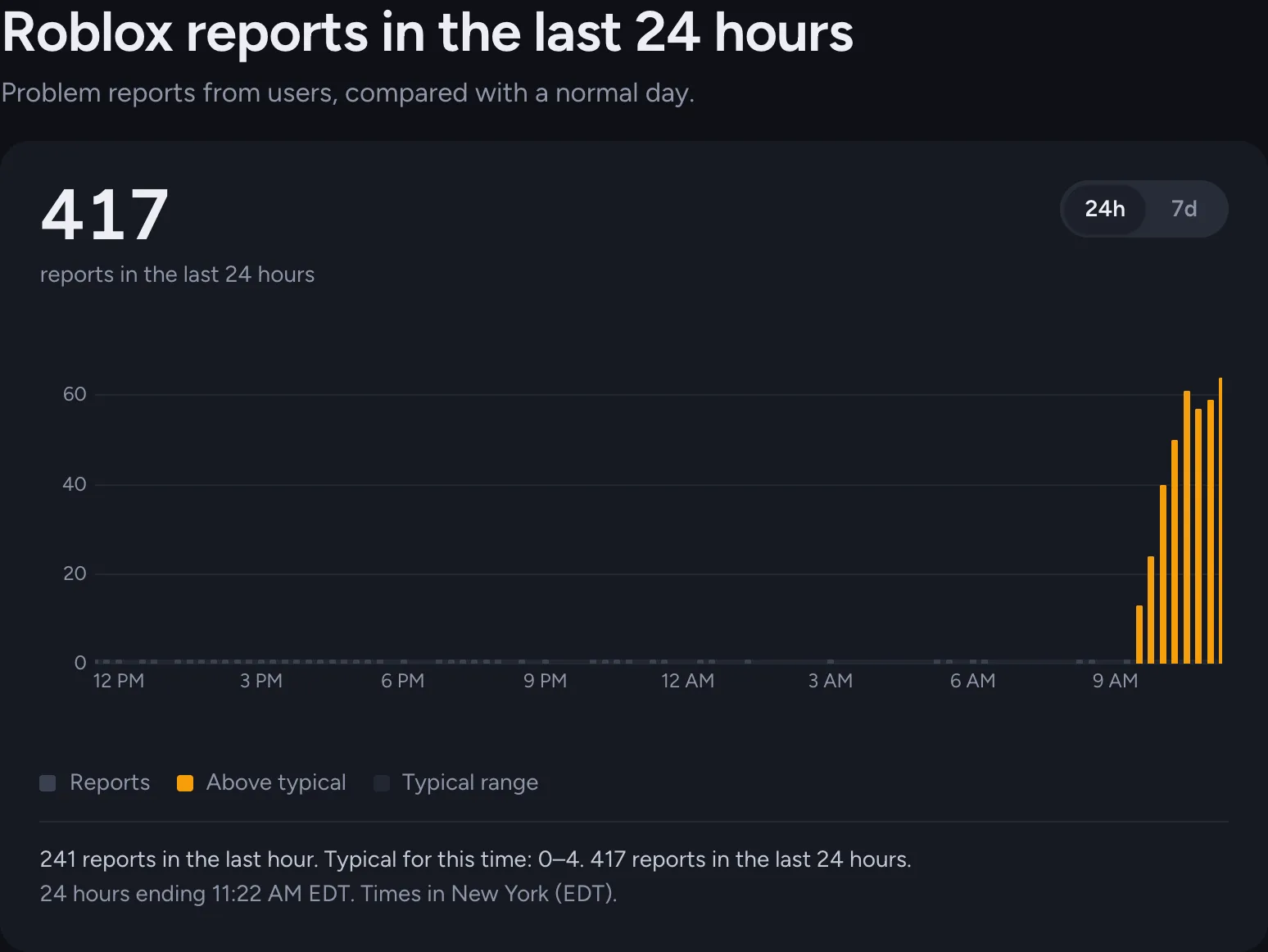
Anyone can press "I have a problem" and pick what is not working. We then compare the reports of the last hour with what is normal for that service at that hour of the day, based on the previous four weeks.
- A few reports on a quiet service do not count as an outage; a clear jump above the usual range does.
- Each visitor's report counts once per service every 30 minutes, so pressing the button again changes nothing.
- One network can add at most 10 reports per service every 30 minutes, and one address at most 10 reports an hour across all services, so a single source cannot fake an outage.
- Reports from data centers, bots and automated traffic are dropped.
- Locations are worked out from the IP address and are approximate. Areas with very few reports are hidden on the map.
What people report
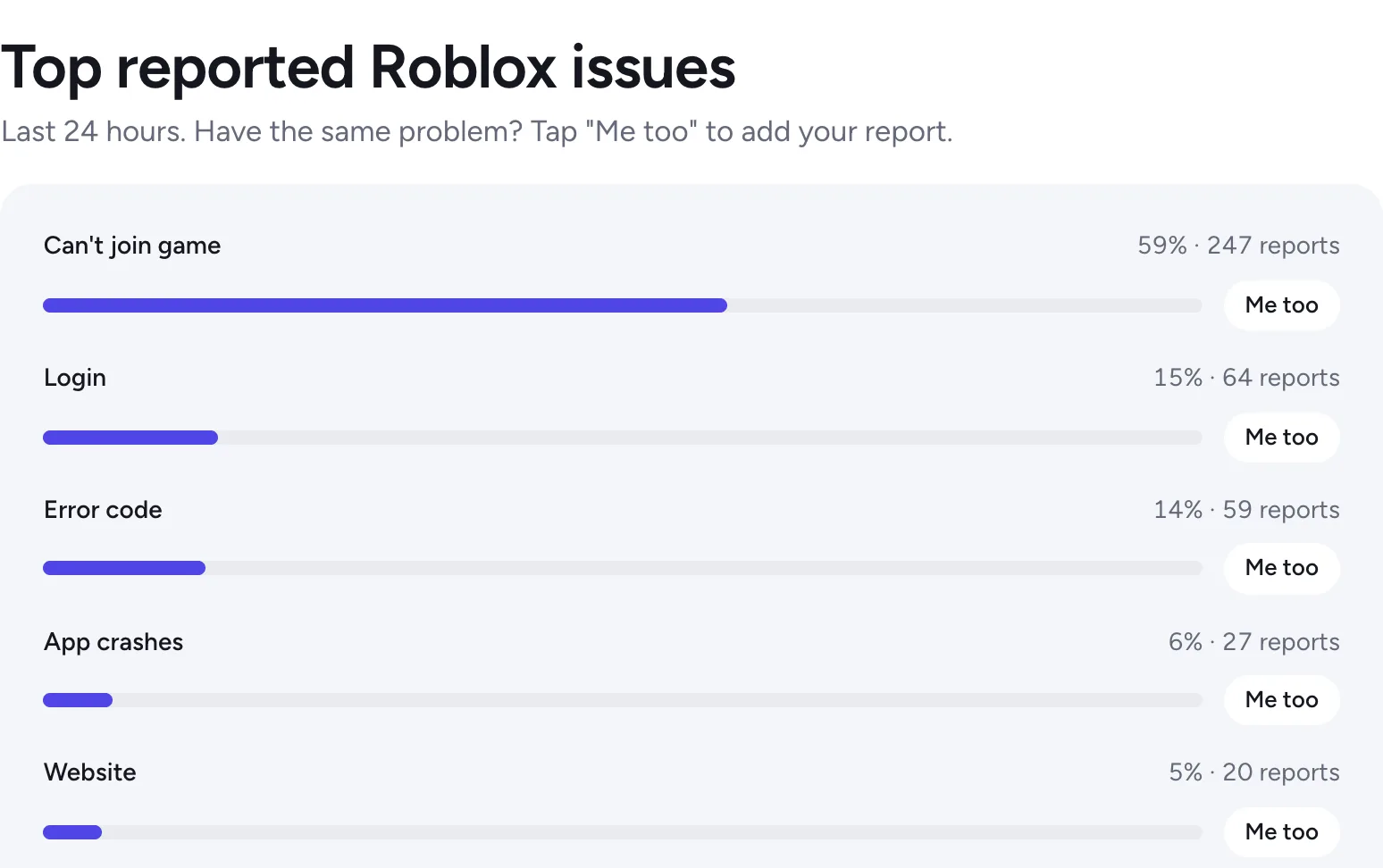
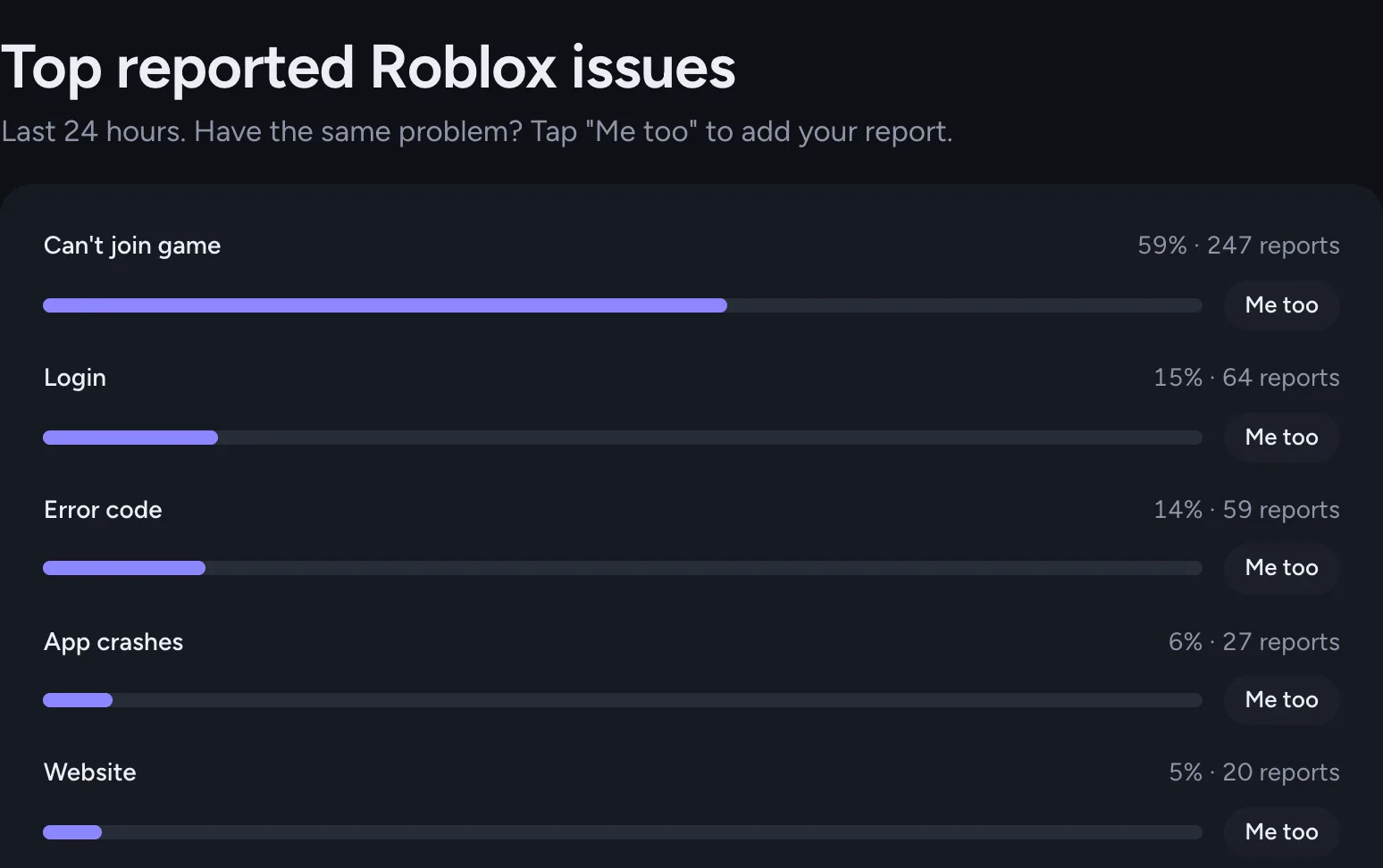
Each service has its own list of problems to pick from, such as login, payments or "can't join game". The lists are built from what visitors actually report and grouped by type of service, so the counts show not only that something is wrong but what.
Our own checks of websites
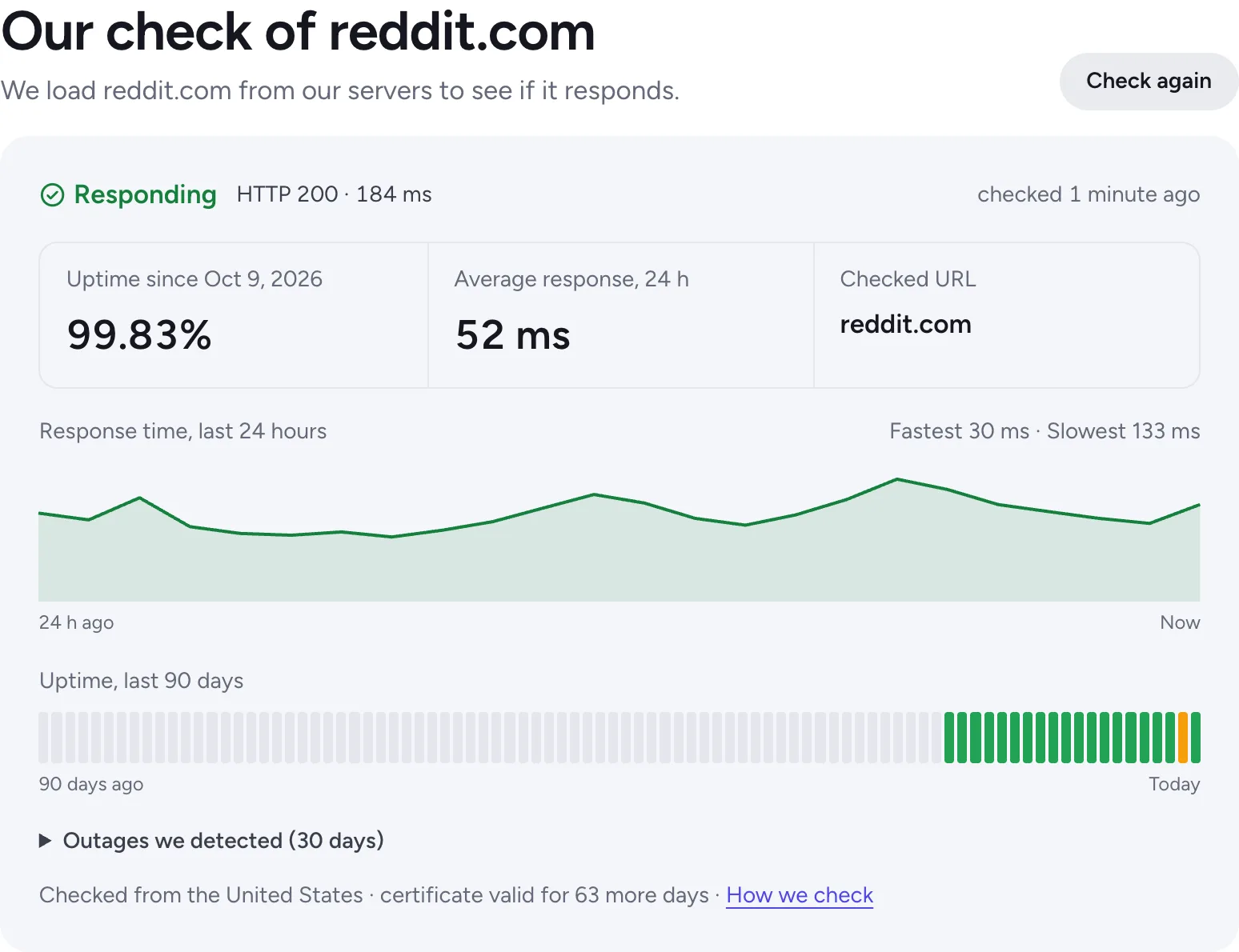
For services that are websites, we also load the site ourselves, from our own servers in Italia. Apps, games and internet providers have no single page that shows whether they work, so for them we rely on reports and, where there is one, the official status page.
Each check is one request for the site's home page, the way a browser would ask for it:
- We look up the domain name, connect, verify the security certificate and request the page, timing each step. We follow up to 5 redirects.
- A check passes when the site answers with a normal response within 10 seconds (and with the expected text, where we look for it). An answer that takes more than 5 seconds counts as working but slow.
- A check fails when the name does not resolve, the connection is refused, the certificate is invalid, nothing complete arrives within 10 seconds, or the site answers with a server error (5xx) or a missing page (such as 404).
- A bot challenge, a country block or an "access denied" answer (403, 429, 451) does not count as a failure. It means the site does not let automated checks in, so it is marked as "can't check automatically" and never as down.
You can watch the checks as they happen, with totals, leaderboards and every website we monitor, on our live monitoring page.
How often we check
- Every 15 minutes: the 10 most searched-for websites.
- Every 30 minutes: the next 900.
- Every 2 hours: all other websites.
- Every 5 minutes while people report problems: as soon as people on at least 3 different networks report a website within 30 minutes, we check it right away and then every 5 minutes. This lasts until an hour after the last report.
- Within a minute after a change: the first failed check, the first blocked answer and the first working check after an outage are each checked again about 60 seconds later before anything changes on the page.
- On request: the "Check again" button on a status page starts a new check within moments, at most once every 10 minutes per website.
The popularity groups are updated every day. Each interval varies by up to 10% so that checks do not all run at once.
How a check becomes "up" or "down"
One bad result is not enough to call a site down, and one good result is not enough to call it back up.
- A site is marked down after 2 failed checks in a row. The outage starts at the time of the first failed check.
- It is marked back up after 2 working checks in a row. A failure that the next check does not confirm is never counted as an outage.
- It is marked as "can't check automatically" after 2 blocked answers in a row.
- When our own connection has problems, results are not used. Every minute we also check 5 very reliable websites (Google, Cloudflare, Wikipedia, Microsoft and Amazon). If 3 or more of them fail, our results are kept but change nothing until the connection is healthy again.
- When many sites seem to fail at once, we hold the change. If more than 5% of the sites checked in the last 10 minutes would turn down, we check again instead of marking them down. A site that keeps failing for 30 minutes is then marked down, because at that point it is a real, wide outage.
- A confirmed outage from our check marks the page as "problems detected". A working check never clears problems that users report, because they can have problems a check of the home page cannot see, such as login or payments.
Adding a website to the checks
A website is not shown with a check result until we trust the result. When a website is added, we check it on the normal schedule without showing anything, and look at the first results:
- 2 working checks in a row: the check appears on its status page.
- The site blocks automated checks: the page says so and relies on user reports.
- The site never worked in at least 3 checks spread over 24 hours, looks parked or for sale, or now redirects to another website: it waits for review. We then check the right address, switch to the service's new address, or take down the page of a service that has closed. Removing a page is always approved by a person.
Uptime and response history
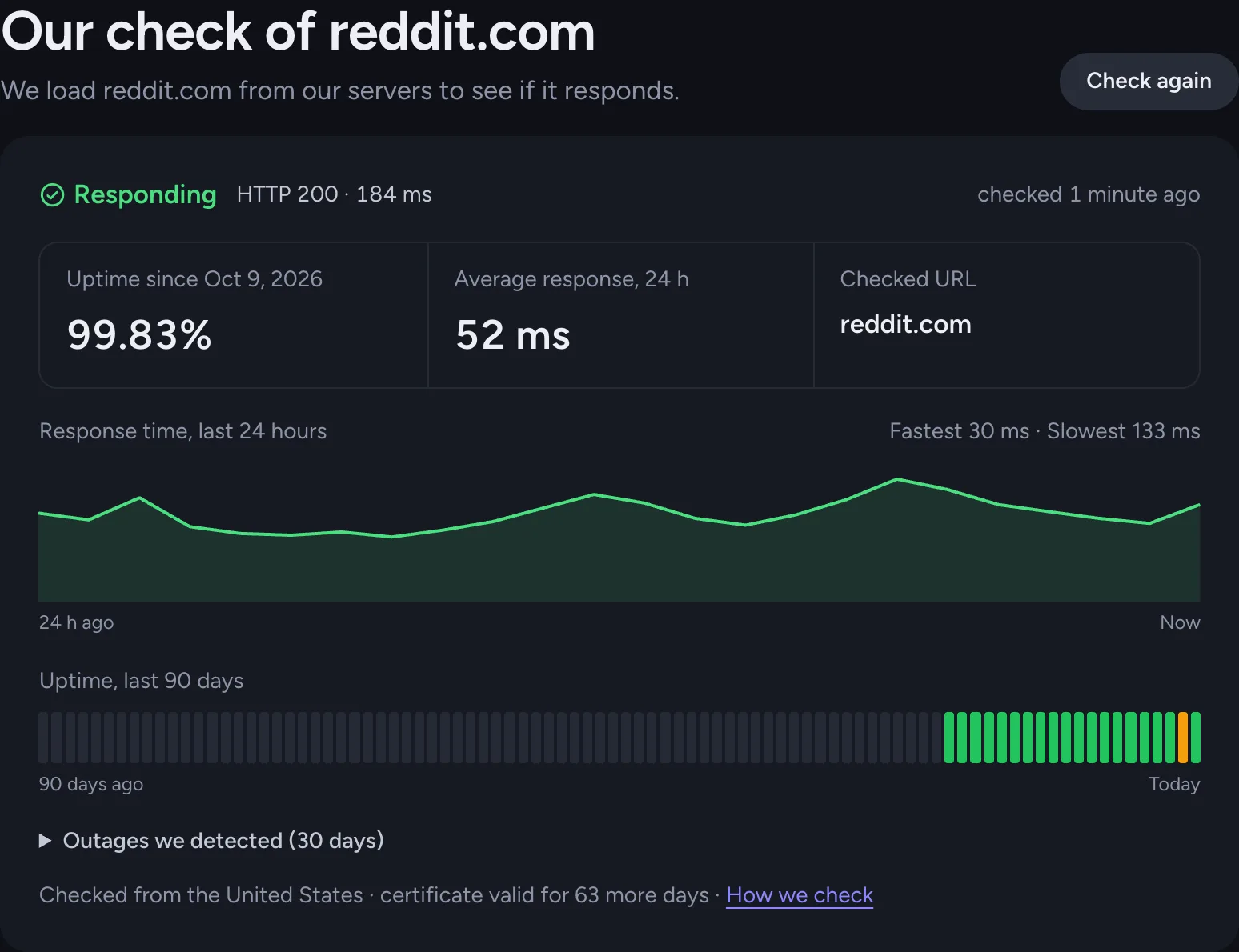
- Uptime is the share of time the site was not in a confirmed outage, since we started checking it, or over the last 90 days once we have 90 days of history.
- The 90-day bar shows one day per bar: fully up, partly down (99% or more up) or down.
- Response time shows hourly averages for the last 24 hours, with the fastest and slowest.
- Outages from our checks are listed for the last 30 days, with when they started, how long they lasted and why (for example "timeout" or "server error").
- Repeat checks, checks made while our own connection had problems and blocked answers are left out of uptime, because they say nothing about the site.
Official status pages
Many services publish their own status page. Where one exists, the service's page links to it and, when the status page offers machine-readable data, shows what it says right next to our own verdict.


- The current official status: all systems operational, some problems reported, partial outage, major outage or maintenance in progress, with the status page it comes from and when we last read it. The list of the service's parts on that page (its "components") can be opened, and the affected ones are named.
- An open official incident: its title, a link to it and when it started.
- When official and user reports disagree, the page says so, for example when users report problems but the official page lists no incident yet.
- "Confirmed" outages: when an official incident overlaps an outage we detected, give or take an hour, the outage in our history is marked as confirmed by that status page.
- Outages our reports missed: up to 5 official incidents that do not overlap any of ours are added to the outage history and marked as official. Incidents the company itself rates as having no impact are left out.
- One status page for several products: we follow only the parts that belong to this service, for example only ChatGPT on OpenAI's page, and skip incidents about the other products.
The official status never replaces our verdict. Status pages are sometimes updated late or describe an outage as smaller than users experience it, so user reports and our checks still count on their own.
How we keep official statuses current
- Every 30 minutes we read each official status page that offers machine-readable data, and its incident feed.
- Every 10 minutes while that page has an open incident, or while users are reporting an outage of the service on our site.
- We ask politely: one request after another, and only for what has changed since the last time, so most status pages answer with a short "nothing new".
- If the official status is more than 2 hours old, because the page did not answer or changed its format, we hide it rather than show something stale. The link to the page stays.
- When a status page stops answering, we try less often (up to once a day). After 20 failures in a row, the service is queued for its official sources to be found and checked again.
- Pages without machine-readable data are linked but not read, so for them the page shows the link only.
How we find official sources
A wrong link is worse than none, so every official source is checked before it is used:
- Only sources the company runs itself: its status page, its incident feed, or a support account that posts about outages (such as Xbox Support). Other outage trackers and fan sites are never used, and our system rejects them.
- A source on the service's own domain is used once its title and contents are confirmed to be that service.
- A source on another domain (such as discordstatus.com for discord.com) is used only when the service's own website links to it. Otherwise a person reviews it first.
- The data feed behind a status page must be readable and match that status page, and the parts we follow must exist on it.
- When a service has no official status page, we record that, and look again every 90 days. Services that have one are checked again every 6 months, and sooner if the page stops answering.
- The search is done by AI agents run by our team, under written rules, as described in our editorial policy. Every change is recorded and can be rolled back.
Outage history
The outage history on each page is built from reports with the same rule as the "problems" label, so the history and the live status agree.
- An outage starts when an hour has at least 10 reports and at least twice the top of the usual range, coming from at least 5 different networks.
- It ends when reports are back within the usual range. Two outages less than 30 minutes apart are counted as one.
- Each outage shows when it started, how long it lasted, the peak and the most reported problem.
Limits of the data
- Reports come from people who visit this site, so they lean toward the countries and devices our visitors use.
- A problem that affects only one region, one network or one app version can be real and still stay below the threshold.
- Our checks run from one location, so a regional outage may not show in them.
- Our checks load the home page only. Login, payments, apps and other parts of a service can fail while the home page works.
- Official status pages are run by the companies themselves. They can be late, and some list only major incidents.
- We are not connected to the services we list. Where a service has an official status page we show what it says and link to it; many services have none.
For website owners
Our checks identify themselves with the user agent isdownusBot/1.0 (+https://isdownus.com/methodology). Each check is a single page request, at most one at a time per site, and we slow down when a site answers "429 Too Many Requests". We never follow links, submit forms or log in.
To stop the checks or correct something about your service, contact us.